
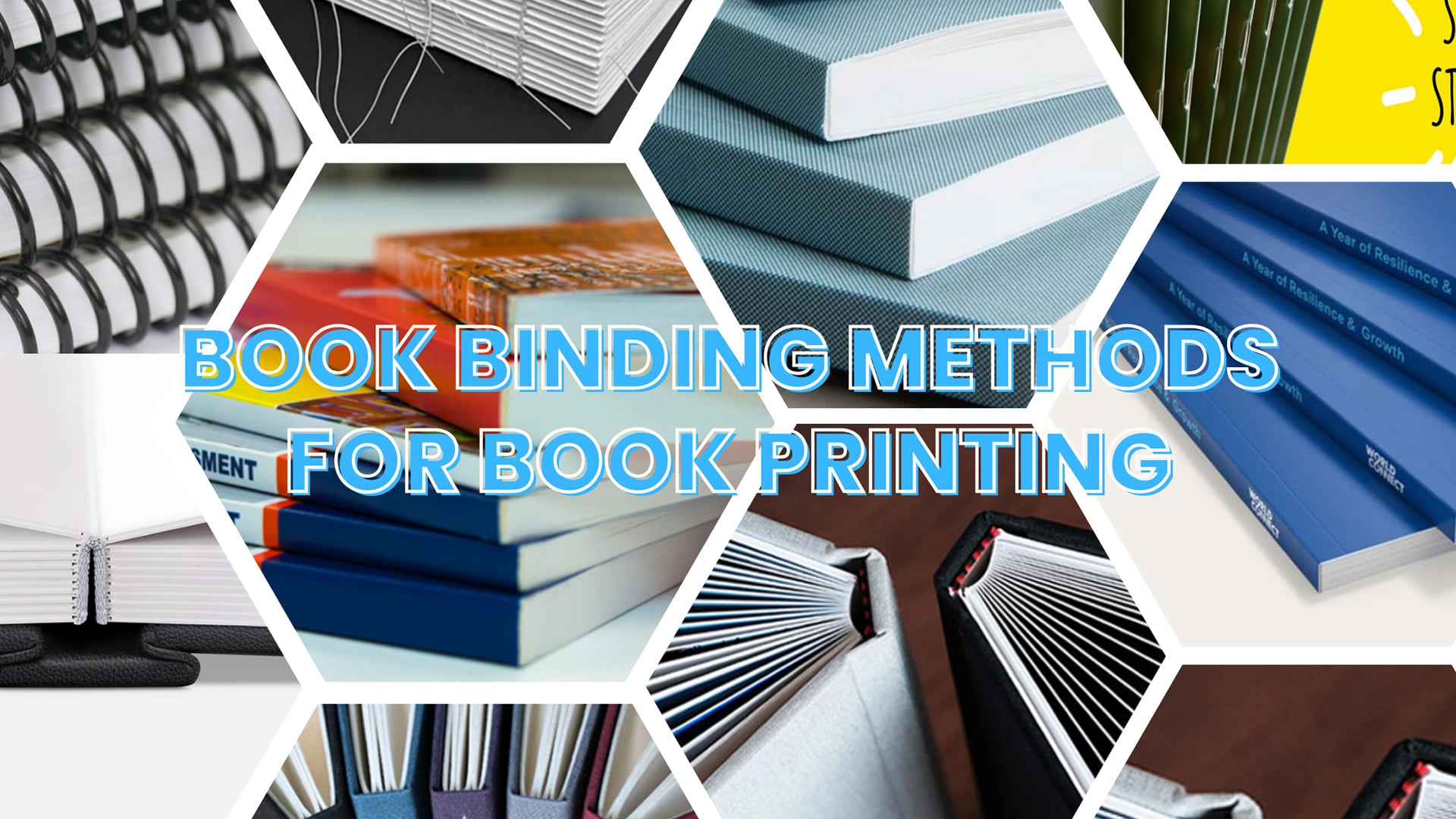





Book binding is more than simply attaching pages together. It shapes how a book feels in the reader’s hands, how long it will last, and how effectively it supports your brand or story. For publishers, brands, and creators working with ChinaBestPrinting, understanding the strengths and limitations of each binding method is the key to choosing the right structure for every project.
This guide explains the most widely used commercial binding methods in modern printing. We will look at durability, cost, appearance, page-count limits, and ideal applications, so you can confidently specify the right binding in your next print job.
- Why the Binding Method Matters
- Main Commercial Binding Methods
- 1. Saddle Stitch Binding
- 2. Perfect Binding (Softcover / Paperback)
- 3. PUR Perfect Binding
- 4. Case Binding (Hardcover)
- 5. Spiral (Coil) Binding
- 6. Wire-O Binding
- 7. Smyth-Sewn (Section Sewn) Binding
- 8. Lay-Flat Binding
- 9. Japanese Stab Binding
- 10. Long-Stitch and Coptic Binding
- How to Choose the Right Binding for Your Project
- Sustainability and Material Choices
- Quality Control in Professional Binding
- Work with ChinaBestPrinting on Your Next Book Project
Why the Binding Method Matters
The binding method directly affects the lifespan, usability, and perceived value of your book. A premium hardcover with sewn signatures can be passed down for decades, while a simple stapled booklet is designed for short-term campaigns and fast distribution.
When you choose a binding method, you are also deciding how the reader will interact with the book, how often it can be used before showing wear, and how strongly it communicates your brand position.
- Durability: Will the book be used for years, or is it a short-lived promotion?
- Reading experience: Does the content benefit from lay-flat opening or wide image spreads?
- Cost: Are you aiming for low unit cost, or for a premium object that can justify a higher price?
- Brand positioning: Does the book need a luxurious, gift-like presence or a straightforward functional look?
- Logistics: Hardcover books weigh more, which impacts freight and storage; spiral bindings may deform under pressure.
Before choosing a binding, clarify your priorities in terms of page count, target audience, intended lifespan, and budget. Once these are clear, the technical choice becomes much easier.
Main Commercial Binding Methods
Below you will find an overview of the most common binding methods used in professional book production. Each method has its sweet spot. Rather than searching for one perfect solution that fits all projects, think in terms of “best fit” for each category of book.
| Binding Method | Durability | Lay-Flat | Typical Cost Level | Typical Applications |
|---|---|---|---|---|
| Saddle Stitch | Low–medium | Opens fairly flat | Low | Brochures, slim catalogs, event programs |
| Perfect Binding | Medium | Limited | Medium | Paperbacks, catalogs, journals |
| PUR Perfect Binding | Medium–high | Better flexibility | Medium | High-use softcovers, export books |
| Case Binding (Hardcover) | Very high | Good, especially when sewn | High | Premium books, children’s books, coffee-table titles |
| Spiral Binding | Good | Fully lay-flat, 360° | Medium | Manuals, notebooks, planners |
| Wire-O Binding | High | Lay-flat | Medium–high | Calendars, corporate presentations |
| Smyth-Sewn | Very high | Good to very good | High | Textbooks, reference books, premium soft/hardcovers |
| Lay-Flat Binding | Medium–high | Excellent | High | Photo books, cookbooks, map books |
| Japanese Stab | Medium | Limited | High | Art books, small gift editions |
| Coptic & Long-Stitch | High | Excellent lay-flat | High | Art journals, design-led editions |
1. Saddle Stitch Binding
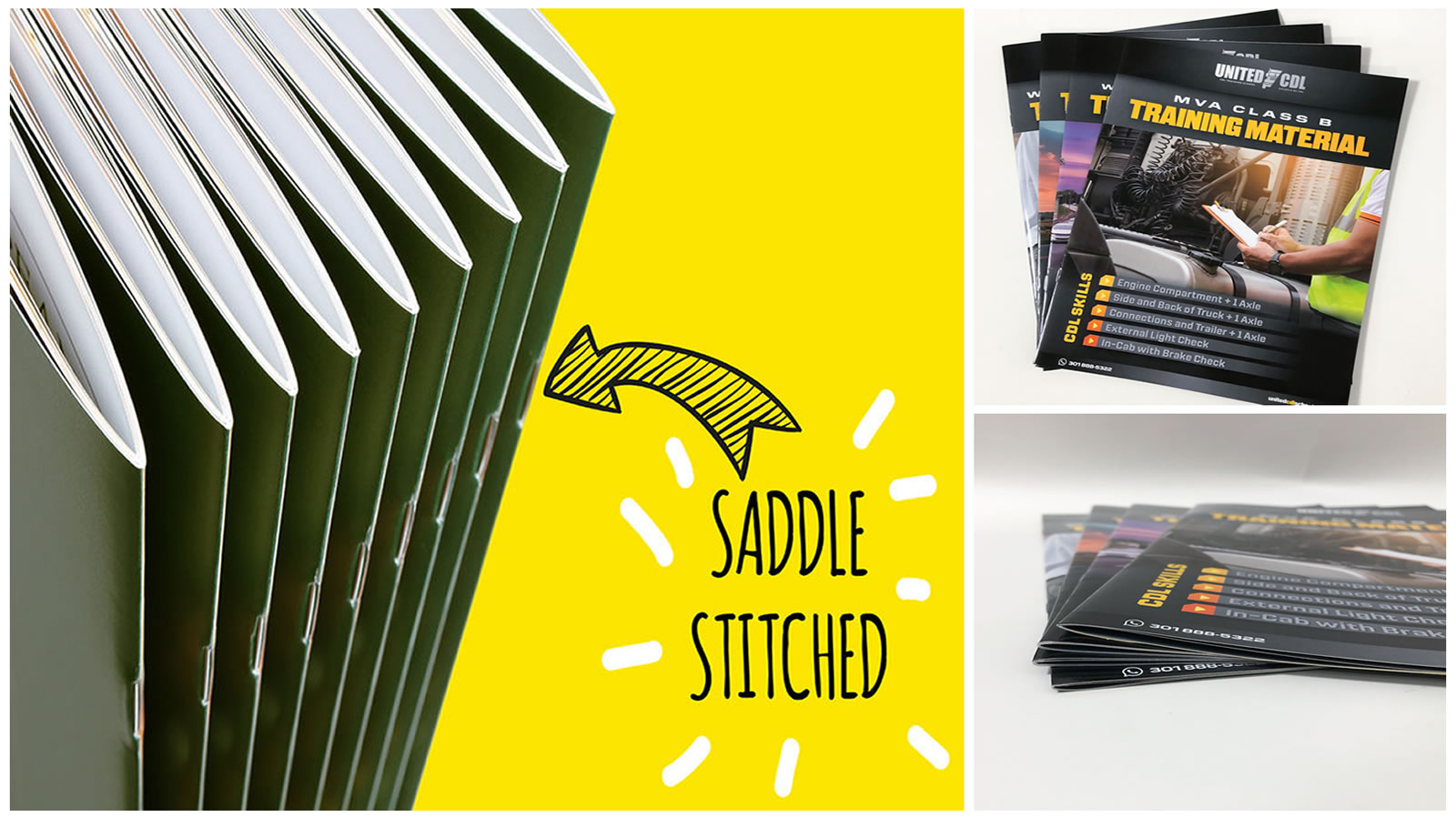
Saddle stitch binding is one of the simplest and most economical methods. Printed sheets are folded in half, nested inside each other, and secured with wire staples along the spine fold. It is common in magazines, event programs, menus, and marketing booklets.
Key Characteristics
- Ideal page count: usually 8–64 pages, always in multiples of four.
- Cost efficiency: very low unit cost, perfect for large distributions and promotions.
- Production speed: fast to set up and run on press and bindery lines.
Advantages
- Budget-friendly for short-lived or frequently updated publications.
- Opens quite flat, making it easy to browse quickly.
- Lightweight and inexpensive to mail.
Limitations
- No square spine — the title cannot be printed on the spine.
- High page counts create “page creep,” causing the inner pages to protrude unless carefully trimmed.
- Less durable; stapled spines are not designed for heavy, long-term use.
At ChinaBestPrinting, saddle stitch is usually recommended for catalogs, brochures, and slim booklets where cost, speed, and lightness are more important than long-term durability.
2. Perfect Binding (Softcover / Paperback)
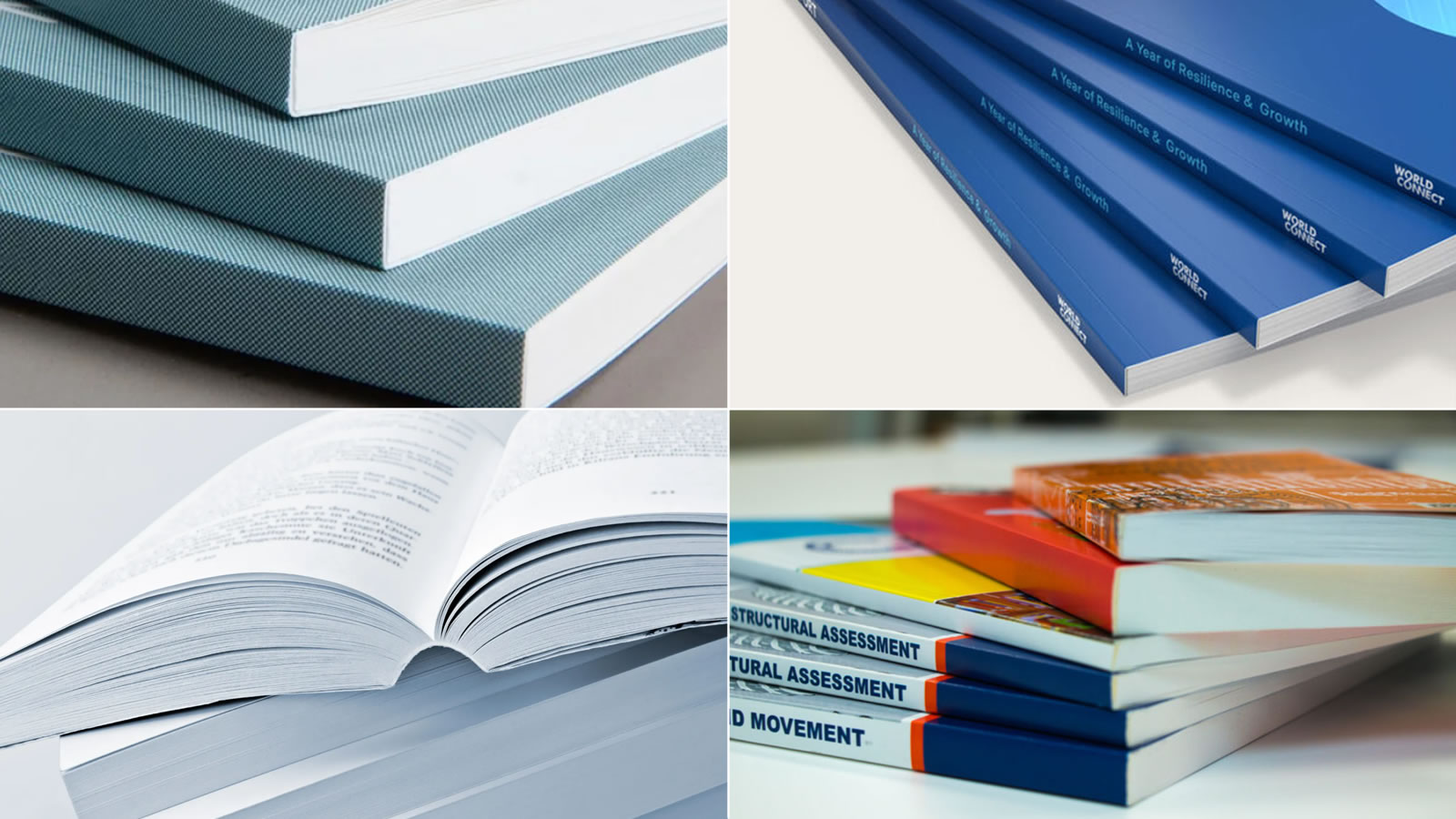
Perfect binding is the standard method for softcover books. The folded sheets are gathered, the spine edge is roughened, and a layer of adhesive is applied. A wrap-around cover is then glued to the spine to form a clean, square-edged book.
Key Characteristics
- Typical page range: around 48–600 pages, depending on paper thickness.
- Spine printing: the squared spine offers excellent visibility on retail shelves.
- Standard adhesive: EVA glue is commonly used for everyday paperback production.
Advantages
- Professional, bookstore-style appearance suitable for most markets.
- Efficient for medium to large print runs.
- Spine can carry the title, author, series, and brand elements for better shelf impact.
Limitations
- Does not naturally lay flat; opening the book very wide stresses the spine.
- With traditional EVA glue, heavy usage can eventually cause pages to loosen.
- Not ideal for workbooks or manuals that need to stay open on a desk.
For most commercial paperbacks, catalogs, and corporate publications, perfect binding strikes a balance between cost and quality. When stronger performance is needed, upgrading to PUR perfect binding is often the best choice.
3. PUR Perfect Binding
PUR binding uses polyurethane reactive adhesive instead of traditional EVA glue. The adhesive reacts and cross-links as it cures, resulting in a spine that is both stronger and more flexible.
Why PUR Matters
- Higher page pull strength: pages are far less likely to detach under stress.
- Better flexibility: the spine bends without cracking, even under repeated openings.
- Climate resistance: PUR performs well in both low and high temperatures, making it ideal for international distribution.
PUR perfect binding is ideal for high-use softcovers such as training manuals, educational books, and premium catalogs. It is especially recommended if your books will be mailed globally or used intensively.
4. Case Binding (Hardcover)
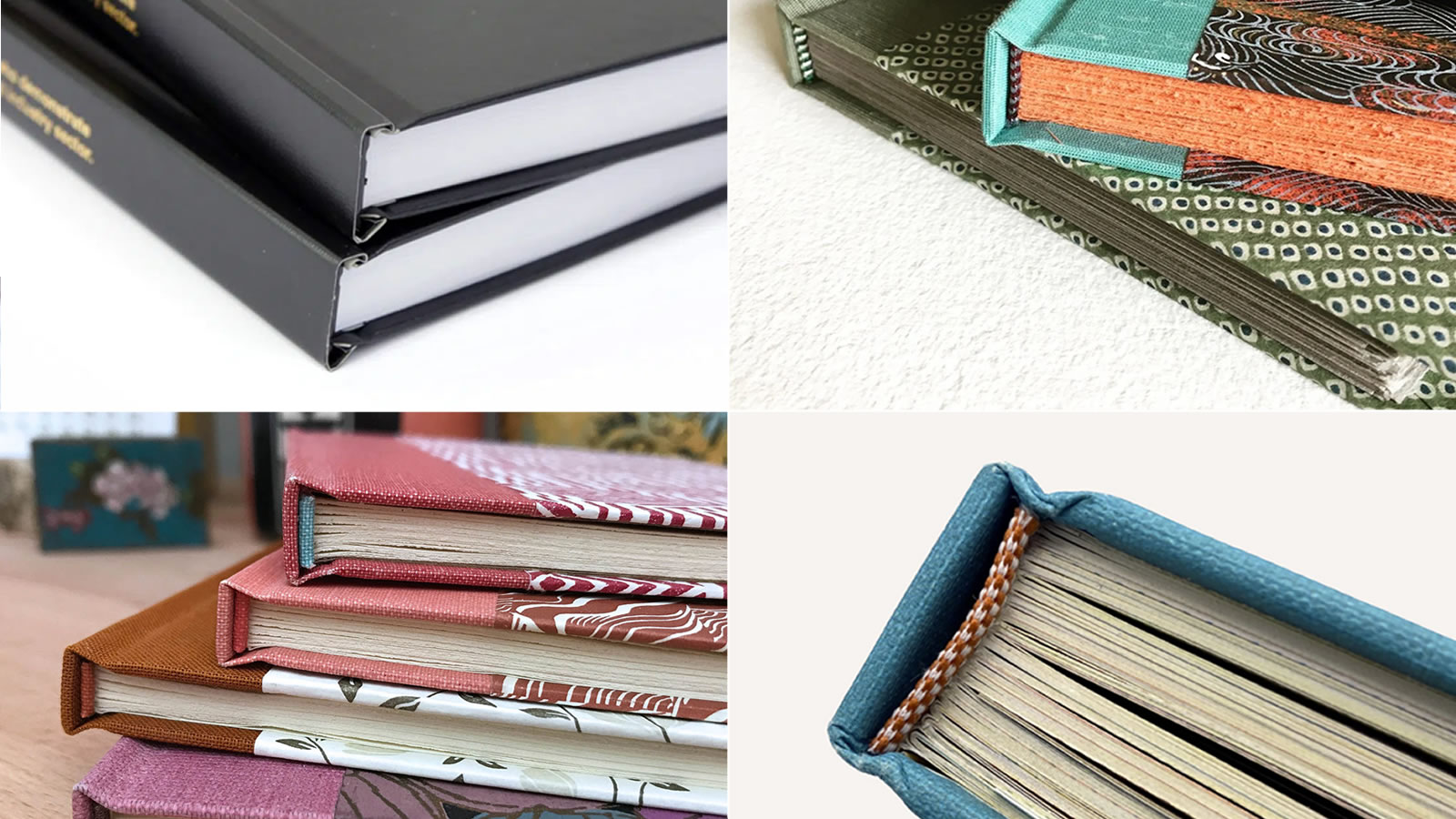
Case binding, commonly known as hardcover binding, is the most durable and prestigious commercial binding method available today. A rigid cover — constructed from thick boards wrapped in printed paper, fabric, or specialty materials — protects the sewn or glued book block inside. This structure gives the book outstanding longevity, excellent shelf presence, and a premium tactile feel suitable for high-value publications.
How Case Binding Works
The internal pages are usually arranged in folded signatures and stitched together, forming a strong book block. Reinforced endpapers are then glued across the inside of the cover boards, securely attaching the text block to the hardcover case. Unlike softcover books, the cover is produced separately before being joined to the pages — a hallmark of traditional book craftsmanship.
Key Characteristics
- Typical minimum thickness starts around one-eighth inch (≈ 64 pages on 50–60 lb. text paper).
- Maximum practical thickness is around 2 inches (≈ 1,000 pages) before multiple volumes are recommended.
- Available with square or rounded spines depending on design and thickness.
- Endpapers carry the primary load of attaching the book block — essential to durability.
- Visible “hinges” beside the spine improve openability and protect the boards during use.
Finishing Options
- Cover materials: laminated paper, cloth, faux leather, genuine leather.
- Premium features: foil stamping, embossing/debossing, spot UV.
- Add-ons: dust jackets, ribbon markers, headbands and tailbands.
Advantages
- Exceptional protection and long service life.
- Premium perception suitable for retail displays and gift-worthy books.
- Highly compatible with branding-focused luxury finishes.
Limitations
- Higher unit cost than softcover or mechanical bindings.
- Longer production schedule due to multiple manual and equipment steps.
- Heavier construction increases shipping and warehousing costs.
When combined with Smyth-sewn signatures, case binding becomes the gold standard for durability — ideal for children’s books, school textbooks, reference volumes, archival editions, art monographs, and institutional publications designed to last for decades.
Case Binding vs. Perfect Binding
| Aspect | Case Binding (Hardcover) | Perfect Binding (Softcover) |
|---|---|---|
| Cover Structure | Rigid boards wrapped with printed paper, cloth, or leather-like materials; text block attached via glued endpapers. | Single soft cover made from heavy paper or card that wraps around and is glued directly to the spine edge of the pages. |
| Durability | Very high durability and excellent protection, especially when combined with Smyth-sewn signatures. | Moderate durability; suitable for everyday use but less resistant to heavy, long-term handling. |
| Appearance & Perception | Premium, gift-worthy look; ideal for high-end markets, libraries, and long-lasting reference books. | Professional, bookstore-style appearance; well suited to trade paperbacks and commercial catalogs. |
| Production Complexity | More complex process with separate cover manufacturing and casing-in; typically requires specialized bindery equipment. | Simpler workflow; often completed in the same facility that prints the interior pages. |
| Lead Time | Longer production timelines due to additional steps and drying/curing stages. | Generally faster turnaround, suitable for time-sensitive projects. |
| Cost Level | Higher unit cost but higher perceived value and potential retail price. | More economical, especially at medium and large print runs. |
| Typical Applications | Children’s books, art and photo books, institutional histories, gift editions, archival reference works. | Trade paperbacks, business books, catalogs, manuals, and general market titles. |
In practice, both methods can deliver a professional result, but case binding is the better choice when longevity, perceived value, and protection are top priorities, while perfect binding is ideal where cost, weight, and fast production are more important.
5. Spiral (Coil) Binding
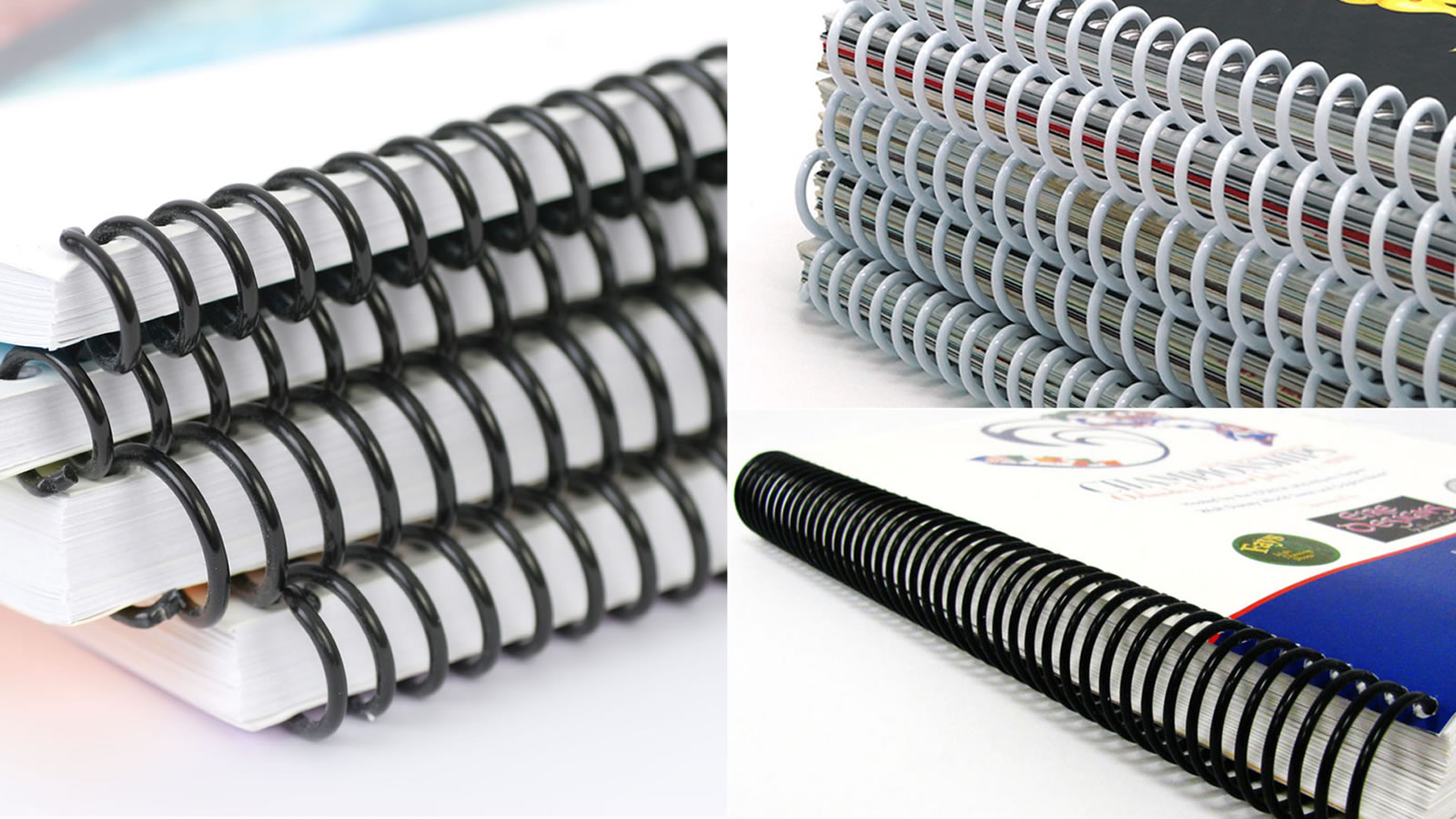
Spiral binding, also called coil binding, uses a continuous plastic or metal coil threaded through punched holes along the binding edge. The pages can rotate a full 360 degrees.
Advantages
- Completely lay-flat and backward folding, perfect for note-taking and reference.
- Easy page turning, especially for thick workbooks and manuals.
- Coils are available in various diameters and colors for visual customization.
Limitations
- Less formal appearance than a square-spine book.
- Coils may warp if heavily compressed during shipping or storage.
- Spine cannot carry printed title information.
For internal training manuals, engineering documentation, and classroom workbooks where function is more important than shelf presence, spiral binding is often the most practical choice.
6. Wire-O Binding

Wire-O binding uses a double-loop metal wire threaded through punched holes. It offers a cleaner, more professional look than standard spiral binding while retaining lay-flat functionality.
Advantages
- Very stable and durable for frequent handling.
- Pages open smoothly and stay flat on a desk, ideal for presentations and calendars.
- Modern, refined appearance suitable for business and design applications.
Limitations
- Costs slightly more than plastic spiral binding.
- The book cannot always be folded completely back without some risk of deforming the wire.
- Like spiral binding, Wire-O does not allow for a printed spine.
7. Smyth-Sewn (Section Sewn) Binding
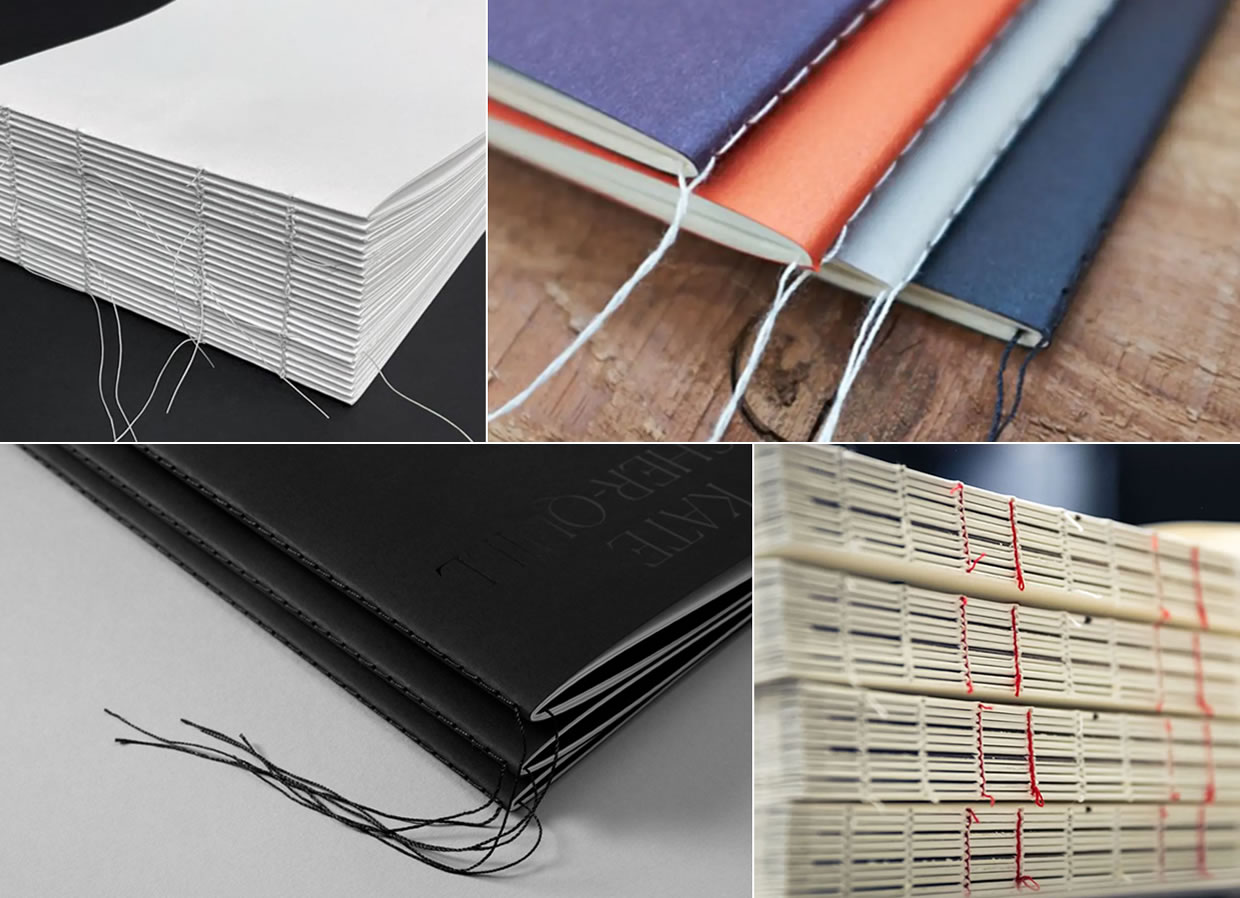
Smyth-sewn binding, also known as section sewing, is a high-end technique in which folded signatures are stitched together with thread before being glued into a cover. It is commonly used inside both softcover and hardcover books when long-term durability is required.
Advantages
- Very strong structure; pages resist pulling out even under heavy use.
- Books open more comfortably and tend to lie flatter than purely glued bindings.
- Ideal for thick volumes and reference books that need a long service life.
Limitations
- Higher production cost and more complex bindery steps.
- Longer lead times compared with simple perfect binding.
If you expect your book to be used daily in classrooms, libraries, or professional environments, Smyth-sewn binding is often the most cost-effective choice over the book’s lifetime.
8. Lay-Flat Binding

Lay-flat binding is a category of constructions designed specifically to let books open perfectly flat across the gutter. This is essential for visual content that spans two pages, such as photography, design portfolios, maps, and step-by-step cooking instructions.
Characteristics
- Special adhesives, hinge structures, or spine-free constructions allow full spread viewing.
- Often used with heavy coated paper to maximize image quality.
- Can be combined with both softcover and hardcover formats.
Pros & Cons
- Pros: flawless presentation of panoramic images; excellent usability on tables and counters.
- Cons: more complex manufacturing and higher unit cost; thicker spine profile compared with standard perfect binding.
9. Japanese Stab Binding

Japanese stab binding is a traditional side-sewn method, in which holes are punched near the binding edge and decorative stitching patterns are used to hold the pages and cover together. It is less common in mass production but highly valued for special editions and artistic projects.
Advantages
- Distinctive, handcrafted look with visible thread patterns.
- Strong binding when executed properly.
- Excellent for limited editions, gift books, and cultural projects.
Limitations
- Books do not open fully flat; inner margins must be designed carefully.
- Labor-intensive stitching raises production cost.
- Less suitable for thick, high-page-count projects.
10. Long-Stitch and Coptic Binding

Long-stitch and Coptic bindings are traditional hand-sewn techniques that expose the sewing structure on the spine. With Coptic binding in particular, the spine is completely uncovered, and the chain stitch allows pages to open perfectly flat.
Why Creatives Love These Methods
- Lay-flat performance: ideal for sketchbooks, journals, and art books where the gutter must not interfere.
- Artisanal appearance: visible sewing adds character and uniqueness.
- Durability: hand-sewn structures are surprisingly strong when crafted correctly.
Considerations
- Not typically used for large industrial runs due to labor requirements.
- Spine cannot hold printed text, so shelving visibility is limited.
- Best reserved for design-led projects and special series where craft is part of the story.
How to Choose the Right Binding for Your Project
Instead of asking “Which binding is best?” a more useful question is “Which binding is best for this specific book?” Here is a quick decision framework used by many of our professional clients.
Start with These Questions
- Who will read or use the book, and in what context?
- Will the book be used occasionally or intensively every day?
- Is it more important to minimize cost, or to maximize perceived value and lifespan?
- Does the content benefit from lay-flat opening or panoramic images?
- Will the book live on retail shelves, on coffee tables, or in classrooms?
Practical Recommendations
- Marketing brochures, slim catalogs, event handouts: choose saddle stitch for maximum cost efficiency at lower page counts.
- Standard trade paperbacks, corporate books, and catalogs: use perfect binding for a clean, bookstore-style look.
- High-use manuals, training books, thicker softcovers: upgrade to PUR perfect binding for better durability.
- Premium children’s books, coffee-table books, gift editions: select case binding (hardcover), preferably with Smyth-sewn signatures.
- Workbooks, planners, and technical manuals for desks: go for spiral or Wire-O binding so the book can lie flat or fold back.
- Photography, portfolio, design, and cookbooks with wide images: invest in lay-flat binding constructions.
- Limited editions and artistic projects: experiment with Japanese stab binding, long-stitch, or Coptic binding.
Sustainability and Material Choices
Many brands are now asking how binding choices impact environmental performance. While binding itself is only one component, it interacts closely with paper selection and cover materials.
- Use FSC-certified or recycled papers where appropriate.
- Opt for recycled board in hardcover cases to reduce virgin material usage.
- Consider soy-based inks and water-based coatings.
- Discuss with your printer whether the chosen binding can be easily recycled in your target market.
Quality Control in Professional Binding
At an industrial printer like ChinaBestPrinting, binding quality is monitored through multiple checks:
- Spine pull tests to ensure pages resist detachment.
- Opening and page-turn tests to check cracking, noise, and stiffness.
- Alignment checks for squareness of the spine and trim accuracy.
- Sample inspections for cover lamination, corner strength, and hinge integrity.
These processes help ensure that the binding you choose not only looks correct in a photograph, but also performs reliably in real-world use.
Work with ChinaBestPrinting on Your Next Book Project
Whether you are a publisher, brand, designer, or independent author, the binding method you choose will strongly influence how your book is perceived and how long it lasts. By combining the right binding with suitable materials and finishes, you can ensure that your project meets both functional needs and aesthetic expectations.
At ChinaBestPrinting, our production team can evaluate your page count, format, budget, and usage scenario, then recommend the most suitable binding structure—from economical saddle-stitched booklets to archival-grade Smyth-sewn hardcovers and high-impact lay-flat photo books.
Ready to discuss your next book? Get in touch with ChinaBestPrinting for a tailored binding recommendation and a detailed quotation.
FAQ: Common Questions About Book Binding
Everything You Need to Know Before Choosing the Right Binding for Your Book
Which binding is the most economical?
For short, lightweight publications, saddle stitch is usually the most economical option. For thicker books, perfect binding delivers a professional look at a reasonable cost.
Which binding lasts the longest?
A combination of Smyth-sewn signatures with case binding offers the highest level of durability. These books can withstand heavy daily use for many years.
What if my book must lie completely flat?
Choose spiral or Wire-O binding for functional, everyday books, or lay-flat binding for high-end visual presentations and photo books. Coptic binding is also an option for art-led projects.
Can softcover books be very durable?
Yes. Using PUR glue and appropriate paper stocks, a softcover book can be surprisingly durable. For training materials and educational books, PUR-bound softcovers are often the most practical solution.
How do I decide between hardcover and softcover?
Consider the expected lifespan, target price point, and brand positioning. Hardcover books offer a premium, durable presence and can support a higher retail price. Softcovers are lighter, more affordable, and often better for mass-market distribution.
How do I choose the best binding method for my book?
Start from how the book will be used. For short-lived or promotional pieces, economical saddle stitch is often enough. For standard trade books and catalogs, perfect binding offers a professional look. If your book will be used intensively or shipped worldwide, upgrade to PUR perfect binding. For premium, long-life projects, case binding (hardcover) with Smyth-sewn signatures is usually the most robust choice.
What is the minimum and maximum page count for different bindings?
- Saddle stitch: commonly from 8–64 pages, always in multiples of 4.
- Perfect / PUR binding: roughly 48–600 pages, depending on paper thickness.
- Case binding: usually from around 80 pages upward for a stable spine.
- Spiral / Wire-O: very flexible; can handle both thin booklets and very thick manuals.
Final limits depend on trim size and paper gsm, so it is best to ask your printer to confirm safe ranges for your exact specs.
What is the difference between standard perfect binding and PUR binding?
Both methods create a square spine softcover, but they use different adhesives. Standard perfect binding typically uses EVA glue, which is suitable for many everyday books but can become brittle over time or in extreme temperatures. PUR glue chemically cross-links as it cures, providing much higher page pull strength and better flexibility. PUR-bound books are more resistant to cracking, page loosening, and climate changes, which is why they are preferred for high-use manuals, thick catalogs, and export titles.
When should I choose hardcover (case binding) instead of softcover?
Choose hardcover when the book needs a long lifespan, a premium feel, or strong impact as a gift or display piece. Children’s picture books, coffee-table photography, institutional histories, and commemorative publications often benefit from case binding. Softcover is more appropriate when you need lower cost, reduced weight for shipping, or a more casual market position, for example mass-market paperbacks or frequently updated training materials.
Which binding methods allow the book to lie completely flat?
If lay-flat performance is critical, choose one of the following:
- Spiral binding and Wire-O binding allow 360° rotation and easy note-taking.
- Special lay-flat constructions are ideal for photo books, portfolios, maps, and cookbooks with images across the gutter.
- Coptic binding offers a fully exposed, flexible spine for art-led projects and journals.
Standard perfect binding and many hardcover constructions will open reasonably well, but they are not truly lay-flat and can be uncomfortable for continuous reference on a desk.
Why does “page creep” happen in saddle-stitched books, and how is it handled?
In saddle-stitched books, multiple folded signatures are nested inside each other. The inner pages need to travel farther around the fold, so their fore-edges protrude slightly more than the outer pages—this effect is called page creep. Professional binders compensate by adjusting the page layout and trimming the finished book to a clean edge. When page counts or paper weights become too high, creep control is no longer practical, and another binding method such as perfect, PUR, or wire binding is recommended.
How much does the binding method affect the total cost of a book project?
Binding is only one element of total cost, alongside paper, printing method, format, and finishing. However, it can still make a noticeable difference:
- Lowest cost: saddle stitch for slim booklets and brochures.
- Mid-range: perfect binding and most spiral / Wire-O bindings.
- Higher cost: PUR, lay-flat, and case binding, especially with sewn signatures and special finishes.
For many projects, upgrading to a stronger binding like PUR or Smyth-sewn hardcover is justified by longer service life, higher perceived value, and the ability to position the book at a higher selling price.
Will my binding choice affect shipping, storage, and handling?
Yes. Hardcover books are heavier and bulkier, which increases freight and warehousing costs but offers better protection for the pages. Softcovers are lighter and more compact, reducing shipping costs but needing more careful packing for protection. Spiral and Wire-O books require sufficient padding so the coils or wires are not crushed. When planning a large run for export, it is wise to balance binding style with carton weight limits and the shipping method you will use.
What should I consider in my design to suit the chosen binding?
- Inner margins: allow extra gutter space for perfect, PUR, and case binding so text is not lost near the spine.
- Spine width: for perfect and case binding, spine thickness must be calculated accurately for a precise cover layout.
- Cross-gutter images: for standard bindings, avoid placing critical text or faces across the gutter; for lay-flat books, you can design full spreads more freely.
- Punch margin for spiral / Wire-O: keep text and important artwork away from the punched edge.
Sharing your intended binding method with your designer early in the process ensures that the layout will print and bind correctly.
How can ChinaBestPrinting help me decide on binding and avoid problems?
A professional printer does more than simply follow a binding specification. At ChinaBestPrinting, we review your page count, trim size, paper choice, and usage scenario, then recommend the most suitable binding structure and spine thickness. We can flag potential risks—such as very tight gutters, extremely heavy papers in saddle stitch, or oversized spiral books—and suggest practical alternatives before production starts. This collaborative approach helps you avoid costly reprints and ensures that your finished books look and perform as intended in real-world use.
