






Use CMYK to handle photographs and gradients. Use Pantone to lock brand solids. Combine both when you need image depth and strict brand consistency.
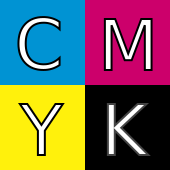
CMYK (Four-Color Process)
CMYK prints tiny C/M/Y/K halftone dots that blend optically into continuous tones—ideal for photos, gradients, and subtle transitions.
- Wide tonal range; reliable for image-heavy layouts.
- Control with ICC profiles and G7/GRACoL; set proper TAC and dot gain per paper.
- Metallic/fluorescent looks are not possible; some brand hues fall outside CMYK gamut.
Best for: photo books, art catalogs, magazines—any layout requiring smooth gradients and rich tonal detail.

Pantone (PMS Spot Inks)
Premixed spot inks print as solid color fields—sharp edges, even coverage, and highly repeatable brand color across runs.
- Excellent for logos, large solids, metallics, and fluorescents.
- Specify coated/uncoated (C/U) correctly; rely on drawdowns—not screens.
- Each added spot requires a plate and wash-up; use only where it matters.
Best for: identity marks, stationery, packaging panels, and special-effect inks that must be exact and repeatable.
CMYK vs Pantone (PMS) — Detailed Feature Comparison
| Feature | CMYK (Cyan, Magenta, Yellow, Key/Black) | Pantone Matching System (PMS) |
|---|---|---|
| Color Method | Uses four process inks (C, M, Y, K) printed as halftone dots to create continuous tones. | Uses pre-mixed, standardized “spot” inks printed as solid fields of pure color. |
| Color Accuracy | Can vary slightly with press calibration, paper, and profile; close but not exact reproduction. | Delivers exact, repeatable color across all print runs and substrates—ideal for brands. |
| Best For | Photographs, gradients, illustrations, and multi-color layouts. | Logos, corporate identity, packaging panels, or elements requiring precise hue control. |
| Gamut / Range | Limited to colors achievable by mixing four inks; cannot reproduce metallic or neon shades. | Extends beyond CMYK gamut; includes metallic, fluorescent, and specialty inks. |
| Edges & Detail | Halftone dots can soften fine edges and small type when built from multiple colors. | Produces crisp, uniform edges on solid vector shapes and text. |
| Consistency / Reprints | Managed with ICC profiles and G7 calibration; minor run-to-run variation possible. | Highly consistent when using the same PMS formulation and paper stock. |
| Proofing | Soft-proof or contract proof with correct CMYK profile and substrate simulation. | Use ink drawdowns or press proofs on target paper for color approval. |
| Setup & Plates | Requires four plates (C, M, Y, K) for one standard print run. | Requires one plate per spot color—each adds setup time and cleanup. |
| Cost | More economical for full-color imagery and long print runs. | Higher setup cost per ink; better suited for brand elements or limited spots. |
| Large Solids | May show banding or unevenness in light tints; careful press control needed. | Solid, even coverage with strong saturation—excellent for large panels. |
| Digital / Short-Run | Native to most digital presses; ideal for small batches and variable data. | True PMS inks require offset or specialty digital units with extra ink stations. |
| Reproduction on Paper | Appearance depends on paper coating and absorbency; dot gain varies. | Choose PMS C (coated) or U (uncoated) for accurate appearance on each stock. |
| Conversion | Pantone→CMYK conversions are approximations; some hues shift noticeably. | CMYK→PMS picks the nearest match; not every process tone has a true spot equivalent. |
| Typical Usage | Magazines, catalogs, art books, marketing collateral with rich imagery. | Corporate identity systems, stationery, packaging, brand color accents. |
| Summary | Best for images and gradients—economical, flexible, and widely supported. | Best for brand-critical colors—precise, repeatable, and visually clean. |
Tip: For mixed layouts, print imagery in CMYK and add 1–2 PMS spots for brand elements to balance cost and color fidelity.
Quick Chooser
- CMYK: Photo-driven layouts (books, catalogs, art). Smooth gradients, broad tonal control, efficient four-color runs.
- Pantone: Logos, packaging solids, and brand-critical hues. Metallic/fluorescent effects and crisp edges.
- Hybrid: Use CMYK for images; add 1–2 PMS spot inks for key identity elements to preserve accuracy.
Color Management Workflow
- Build files in the right space: CMYK with proper ICC; Pantone swatches for spot elements.
- Lock paper early (coated vs uncoated) to set curves, TAC, and expectations.
- Document brand mappings: PMS (C/U) ↔ CMYK/HEX/RGB.
- Soft-proof on calibrated displays; confirm with contract proofs or ink drawdowns.
- Record press density/curves for consistent reprints.
Conversions & Expectations
- Pantone → CMYK: approximate; expect hue/brightness shifts due to gamut limits.
- CMYK → Pantone: choose the nearest PMS; not every process mix has a perfect spot match.
- Proofing first: for brand-critical work, request a press or calibrated contract proof.
CMYK: best for photography and gradients; control with ICC/G7 for consistency.
Pantone: best for brand solids and effects; specify C/U and rely on physical proofs.
Hybrid: CMYK base + 1–2 spot inks balances cost with brand fidelity.
